Los Santos cannot be rebuilt by next week. It will not be rebuilt by Christmas. According to the Preservation Teams’ own inspection figures, obtained by Weazel News, and more than a dozen engineers, contractors and insiders who spoke to us, putting the city back together will take at least a year. In the worst-hit parts of the east, it will take far longer.
The documents, the teams’ rapid-assessment tally and a confidential utilities briefing, show the scale of what lies ahead. In the first day and a half, inspectors reached about one building in fifteen inside the evacuation zone. Almost half were damaged, and 2,184 are unsafe to enter. The tally lists 311 collapsed or partly collapsed buildings where the dead are believed to still be inside. Under the streets are more than a thousand breaks in the water mains, and four substations need equipment that can take two years to build.
The emergency text that emptied the city said Los Santos would be closed “for at least seven days”. On Saturday the Preservation Teams said residents could be allowed back by Thursday 1 October, with free buses leaving Paleto Bay at 10am, the morning October rent falls due. One Downtown employer has already told staff, in a notice seen by Weazel News, to “report for normal duties from Friday 2 October”.
Nothing in the documents says those buses will not run, and the teams themselves describe Thursday as an estimate, not a promise. But a Thursday return and a rebuilt city are very different things, and the gap between them is measured in months and years, not days.
Even if every truck the teams have were to start hauling tomorrow, carrying away the rubble from the buildings inspected so far would take more than a year. At today’s staffing, the engineers who decide which buildings can be saved would need nine months to assess the ones already found. And the State has frozen all disaster aid until at least the second quarter of next year.
What we obtained, and how we checked it
Weazel News has obtained two documents produced inside the evacuation zone. The first is the Preservation Teams’ rapid-assessment tally, the spreadsheet logging every building their inspectors have reached and the placard left on it. Our copy is time-stamped 06:00 on Sunday 27 September and covers 12,480 buildings, with a roster of the people working in the zone, a protocol page and a planning sheet estimating the demolition and debris to come.
The second is a nine-page utilities briefing prepared for the teams’ coordinators on Saturday night, with sections by Gaia Energy engineers and the city’s water engineers, marked “for coordination only, not for release”. It reached us from a third source, and a person who attended the coordinators’ meeting confirmed its contents.
Two people working inside the zone sent us the tally separately; the copies match line for line. We checked 40 addresses against Weazel News drone footage and photos sent to our newsroom. In 38, the placard matches the tally. In the other two, our footage predates the inspection time the tally logs. The briefing’s power and gas figures agree with Gaia Energy’s public statement on Saturday: the Palmer-Taylor plant running at reduced output, and dozens of leaks capped.
Three independent structural engineers, among them Dr Naomi Castellanos, reviewed the tally’s methods; Hal Brennick, a retired city water engineer, and a utilities specialist reviewed the briefing. None found reason to doubt the figures, and several called them optimistic. Gaia Energy declined to comment on “internal planning documents” but did not dispute any figure we put to it. We are not naming our sources.
One building in fifteen
The Preservation Teams’ own planning figure puts the number of buildings inside the evacuation zone at about 186,000. By 06:00 on Sunday, inspectors had reached 12,480: about one in fifteen.
Of those, 6,345 were tagged green: inspectors found no obvious danger. Another 3,951 were tagged yellow, restricted use: people may go in briefly, but nobody should live there until an engineer says so. The remaining 2,184 were tagged red: unsafe, do not enter.
The teams started where the damage was worst, so those proportions do not hold for the whole city. Much of the west side and Downtown came through far better. The east did not.
The swarm before the quake was centred on La Mesa and Murrieta Heights, and it shows. In La Mesa, 804 of the 2,310 buildings inspected are red, more than one in three. In Murrieta Heights it is 611 of 1,640. In Mirror Park, 387 of 1,905 are red and another 702 are yellow. Around the Port of Los Santos, Elysian Island and Cypress Flats, 188 of 1,120 are red. Downtown, Pillbox Hill and Mission Row fared better, with 96 red out of 1,215. Across the other districts surveyed, from Strawberry and Davis to Vespucci, 98 of 4,290 are red.
Of the three main hospitals, Mount Zonah Medical Center is listed as fully usable, Pillbox Hill Medical Center as usable in part, and Central Los Santos Medical Center as closed. Of 58 schools inspected, nine are red and 17 are yellow.
At about 8,500 inspections a day, reaching every building would take roughly three more weeks, until mid-October. In the west, teams are surveying from the road. In the east, they cannot. “In La Mesa you walk into every building, and some of them you can’t walk into at all,” said a structural engineer working with the teams, who asked not to be named because the teams have been told not to talk to reporters.
Green, yellow, red: a first look, not the last word
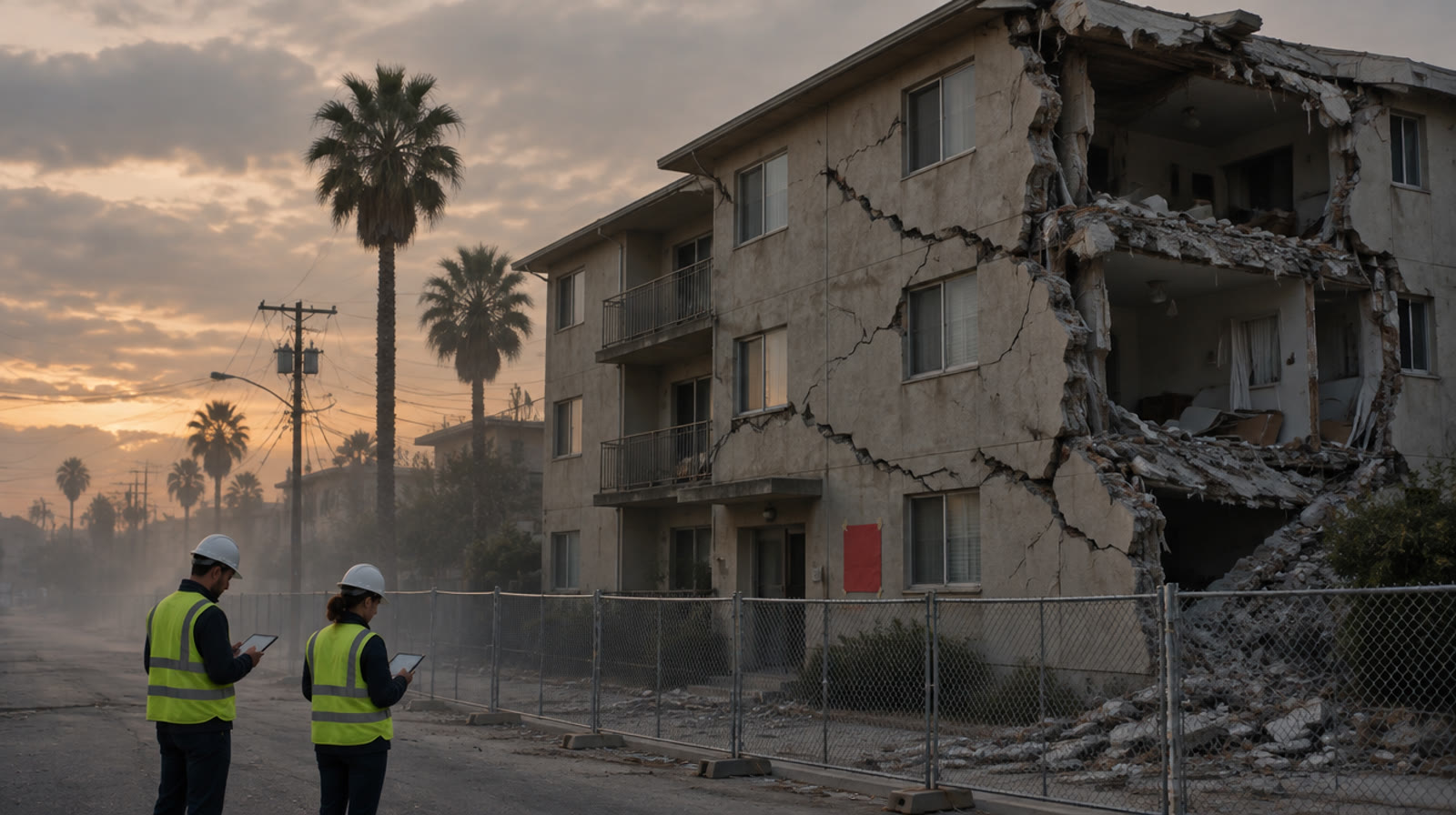
The placards come from a rapid assessment, and it is exactly that. Two inspectors walk around a building looking for obvious danger (a leaning wall, a cracked column, a staircase pulling away) and decide in fifteen or twenty minutes whether it is safe to enter. It keeps people alive; it does not decide whether a building can be saved.
That takes a detailed engineering evaluation: an engineer inside the building, often for days, opening walls and ceilings to see how it is holding together. Every red and yellow building needs one before anybody can repair it, rebuild it or knock it down. The tally lists 6,135 so far. Thirty-seven have been done.
Of the 1,870 people on the teams’ roster, 812 are inspectors working in pairs, 214 truck drivers, 386 water, sewer and power crew, and 412 plant operators, labourers, coordinators and support staff. Just 46 are licensed structural engineers. The fire department’s recovery crews are listed separately.
“Two days per building is a very generous average,” said Castellanos, who has spent 26 years on seismic work in Los Santos. “A family house might be half a day. A six-storey block with a cracked frame can be two weeks.” At two days each, the 46 engineers would need about 265 days for the buildings already found: nine months, without a day off.
Normally, most of that work falls to private engineers hired by owners and insurers. The planning sheet projects 24,000 to 30,000 red and yellow buildings once the whole city is reached. Los Santos has about 600 practising structural engineers; all of them, working every day and paid in full, would need around three months. Today most are in Paleto, their offices and files are often inside the zone, owners cannot pay and insurers cannot get in. Mutual aid would normally bring engineers from other cities. “That system runs through the State,” Castellanos said. “The State has frozen everything.”
“Green means ‘we didn’t see anything that will kill you today’,” she said. “It doesn’t mean fixed. Yellow doesn’t mean fine. And red doesn’t always mean demolish. You only find out which with the second look, and the second look has barely started.”
The dead come first
The Los Santos Fire Department says at least 700 people died in the earthquake, and stresses that 700 is a minimum; firefighters expect the number to rise. The department has moved from rescue to recovery: bringing the dead out so they can be identified and returned to their families.
Among the buildings reached so far, the tally lists 311 collapsed or partly collapsed structures where people are believed to still be inside. No demolition crew can touch them until they have been searched, and the rubble has to be taken apart, often by hand, layer by layer.
“Every one of those is somebody’s mother, somebody’s kid,” said a firefighter working on the recovery, who asked not to be named. “We are not putting a digger through that. We go slow because we have to.”
The tally shows 14 LSFD recovery crews, about 22 sites per crew. The firefighter estimated two days to two weeks per site. Even near the fastest end of that range, two to three days a site, Weazel News calculates the crews would still be working between about 10 November and early December. Some buildings will need shoring up before anyone can go in.
There is one exception. A red building in danger of imminent collapse can be pulled down under an emergency order without the full second look, but only once recovery there is finished, and not beside yellow buildings while aftershocks continue.
The tally does not list a single member of the State Coroner’s staff working inside the zone. The State still recognises only fourteen deaths.
The ground has not finished moving
Every timeline in this story, including Thursday, assumes the ground stays still. Seismologists say it will not.
“The aftershocks have eased, and that is completely normal,” said Professor Elliot Varga, a seismologist at the University of San Andreas. “Eased is not over. A sequence like this carries on for months, and in a smaller way for years.”
Working from the San Andreas Geological Survey’s forecast models, Varga puts the odds of an aftershock of magnitude five or more in the next month at roughly even, and expects several that size within the year.
Under the protocol page attached to the tally, an aftershock of magnitude four and a half or more within 20 miles of the city triggers a fresh inspection of every yellow building in the districts affected: right now, potentially all 3,951. One strong aftershock can undo days of work and turn yellows into reds. It also rules out quick demolition. “Nobody brings a damaged tower down with explosives while the ground is moving and the building next door is yellow,” Castellanos said.
Nearly five million tonnes, and a few roads out
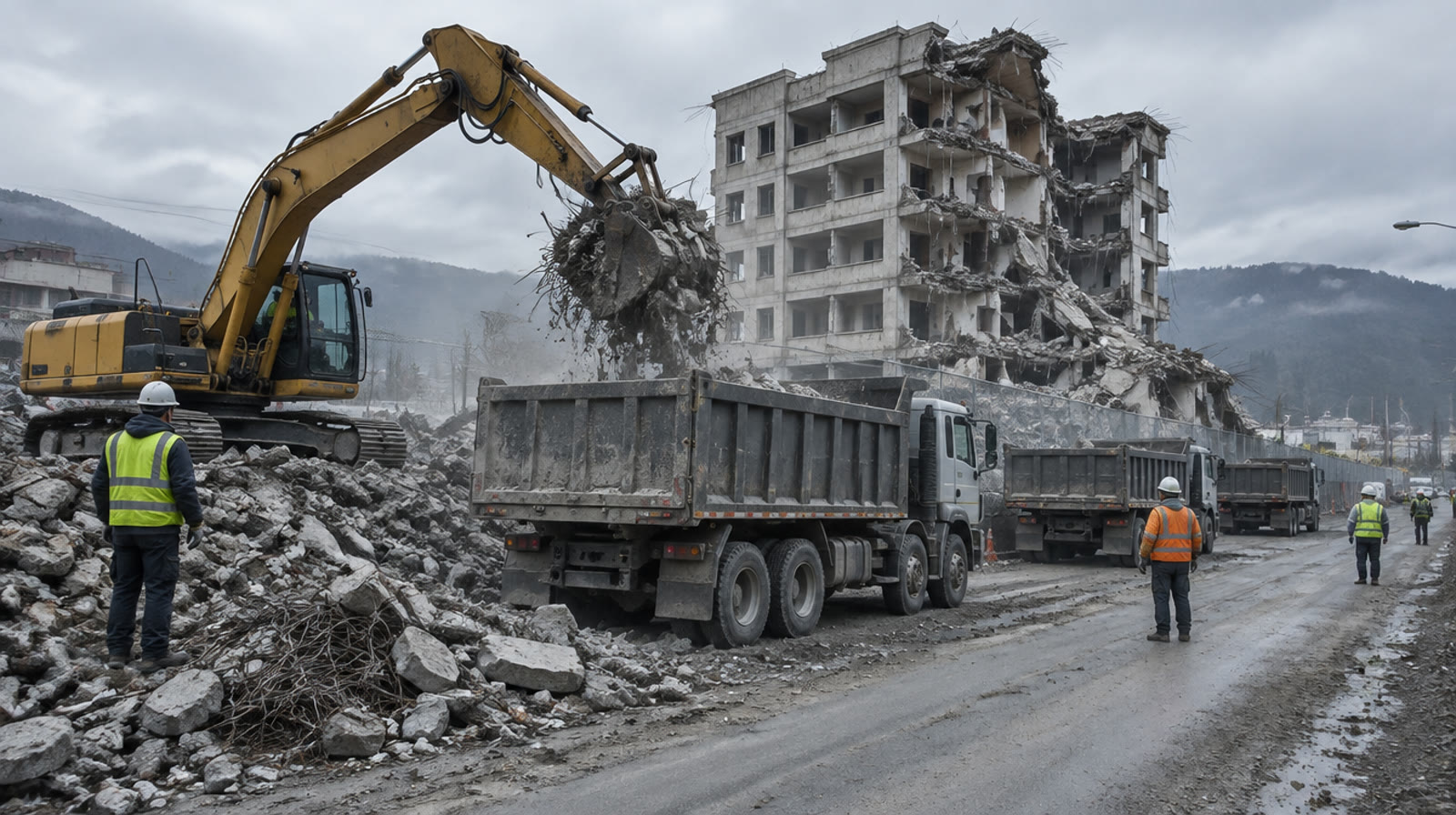
The planning sheet estimates that 1,420 of the 2,184 red buildings, about two in three, will have to be demolished, and puts the debris from the buildings inspected so far at 4.1 to 5.6 million tonnes, with a central estimate of 4.8 million. The red list is heavy with concrete apartment blocks, warehouses and parking structures, each able to leave thousands of tonnes. A timber family home leaves closer to 100.
Ray Delacourt runs a demolition firm in Cypress Flats that his grandfather started. “In a normal year, every demolition firm in this city put together takes down maybe 300 apartment blocks and commercial buildings,” he said. “This is 1,420 before anyone has looked at most of the city.” Many older buildings also contain asbestos that must be removed first.
At 20 tonnes a load, 4.8 million tonnes is 240,000 truckloads. The tally lists 214 heavy tipper trucks inside the zone, and for now they are only pushing rubble off the main roads into holding piles: nothing is yet being hauled out of the city, because nobody has agreed to pay for it. If all 214 were put to work, contractors say each could manage about three round trips a day with loading, checkpoints and the long drive out. That is 642 loads, or 12,840 tonnes, a day. Even at that pace, clearing that debris would take about 374 days. More than a year, and that is only the buildings inspected so far.
It gets worse. The county’s usual crushing and construction-waste yards are in La Mesa and Cypress Flats, inside the zone. That leaves two licensed sites, a fill site in the Grand Senora Desert and a quarry pit in Blaine County, taking about 9,000 tonnes a day between them. At that limit, the same debris takes about 533 days. Crushing concrete inside the city could cut the load by around 40 per cent, the planning sheet says; the remaining 2.9 million tonnes would still take about 320 days.
Those figures are floors, not forecasts: they assume full-speed hauling from tomorrow. Temporary tips and round-the-clock trucking need emergency permits and emergency money, both of which run through the State that has frozen its aid.
Every truck also needs the few roads out, among them the Senora Freeway and the Great Ocean Highway, which the Thursday buses will use. Two haulage contractors said checkpoint crews are extending the State’s 22:00 to 06:00 Paleto Bay curfew to heavy vehicles on the roads in and out, which rules out hauling through the night.
“You need trucks moving 24 hours, you need three or four tips, and you need somebody to pay for it,” Delacourt said. “Right now I’ve got none of those. Nobody has asked me for a price. Nobody can.”
The city under the city
“People think you rebuild a city from the ground up,” said Brennick, who spent 31 years maintaining the city’s water mains. “You rebuild it from the ground down. Sewer first, because it’s deepest. Then water, gas, power, then the road on top. Only then the buildings.”
Water. The briefing lists 1,180 confirmed breaks on water mains, almost all in the east and around the port, and says the real number is higher. At about one and a half breaks a day for each of 38 repair crews, the known breaks take around three weeks. After that, at least 96 miles of main, mostly old cast-iron pipe, is beyond patching. With 30 of those crews laying new pipe at about 150 feet a day each, replacing it takes nearly four more months. Expect to boil your water for weeks.
Sewers. East Los Santos has about 1,100 miles of sewer, and the only way to find earthquake damage is to push a camera through every length of pipe. The briefing lists 12 camera crews, each surveying about half a mile a day: roughly six months just to look inside the sewers of the east, with repairs following behind.
Gas. The briefing records 94 leaks capped or isolated since Friday, and gas still off to about 41,000 homes and businesses in the east. Every buried pipe there must be pressure-tested, and every connection needs a technician’s visit before relighting. The best estimate for the last streets is 10 to 14 weeks: between early December and early January.
Power. The Palmer-Taylor Power Station is running at a little over half its normal output, the briefing says. Of the city’s 38 substations, 27 are working normally, seven are damaged and running at reduced load, and four are out of service. Those four need new large transformers, built to order, which the utilities specialist said take 12 to 24 months to arrive. Gaia’s two spares in the state could bring two of the four back within weeks. The other two will run on trailer-mounted units at reduced load until new transformers arrive.
Gaia’s engineers have done remarkable work in the west and Downtown. But the Gaia section warns: “Full restoration of normal service to La Mesa, Murrieta Heights and Mirror Park should not be assumed before the new year at the earliest.”
Liquid ground and a freeway in pieces
Around the Port of Los Santos, Elysian Island and parts of Cypress Flats, much of the land is reclaimed or loose, wet sand, and in the main shock parts of it behaved like a liquid. The tally records sand boils on Elysian Island, wharves slid towards the water and container cranes off their rails. Most container berths are restricted or closed, and that is where a rebuild’s steel, timber and glass would normally arrive.
“When ground liquefies, a perfectly well-built building on top can still sink, tilt or crack in half,” said Dr Anita Sorensen, a geotechnical engineer who has worked on the port’s wharves. “Before you rebuild, you drill, test the soil and design a fix. That is three to six months before anyone pours a foundation.” A few berths could reopen within weeks on temporary repairs, she said, but full capacity means rebuilding wharves: “Eighteen months to two years, if the money is there.”
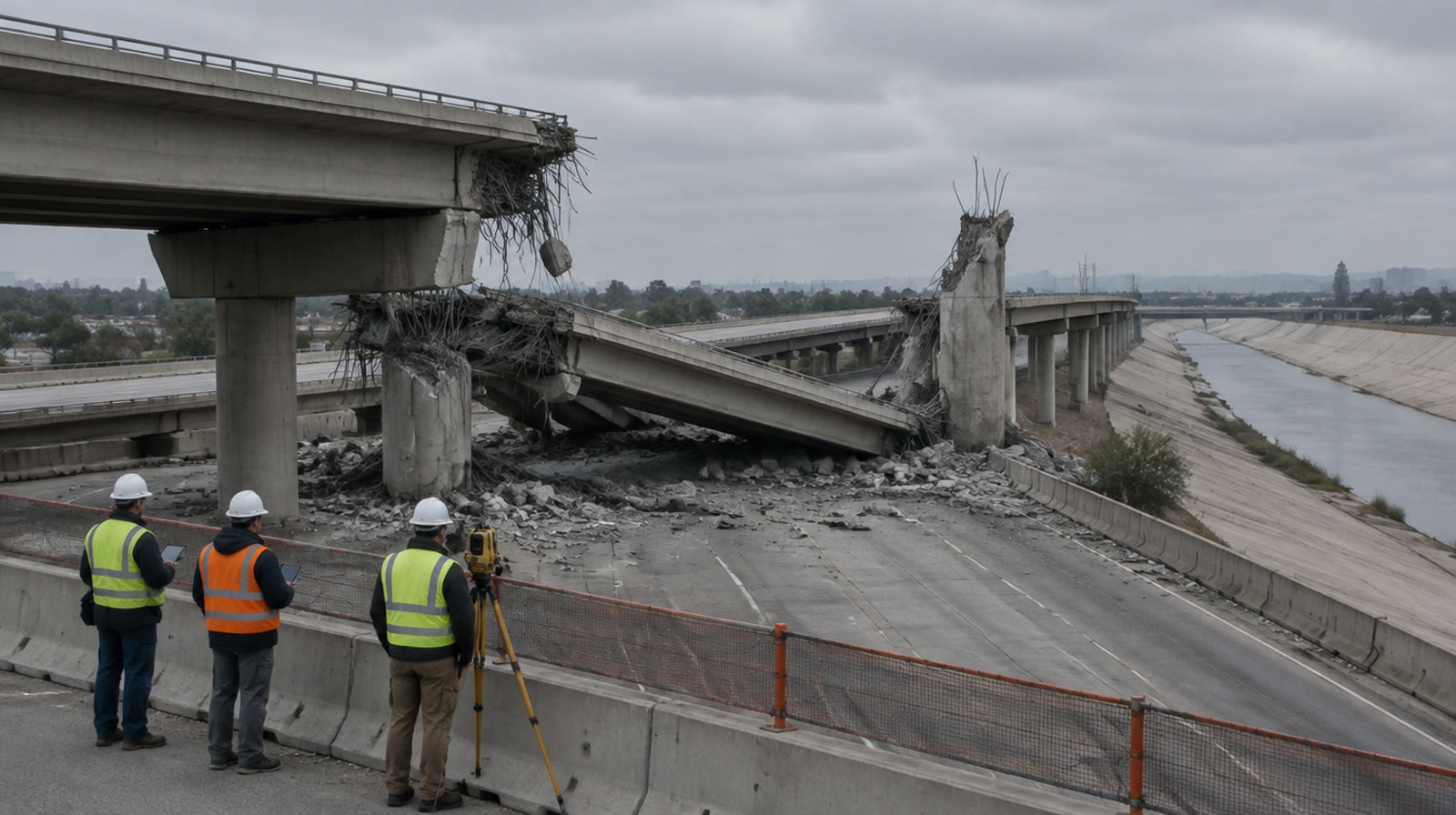
The tally lists 23 freeway structures inspected: ten open, nine restricted and four closed. One of the four, an elevated connector at the interchange above the Los Santos River in La Mesa, dropped a span in the main shock.
A bridge engineer who has inspected the network for two decades, and asked not to be named because of state contracts, said at most one of the four could be propped up and reopened within weeks. “The rest come down and get rebuilt. With bonus contracts and crews working round the clock, a simple span can go back up in two or three months. The connector is not simple. Call it three to eighteen months, with money. With no money, it is nothing.”
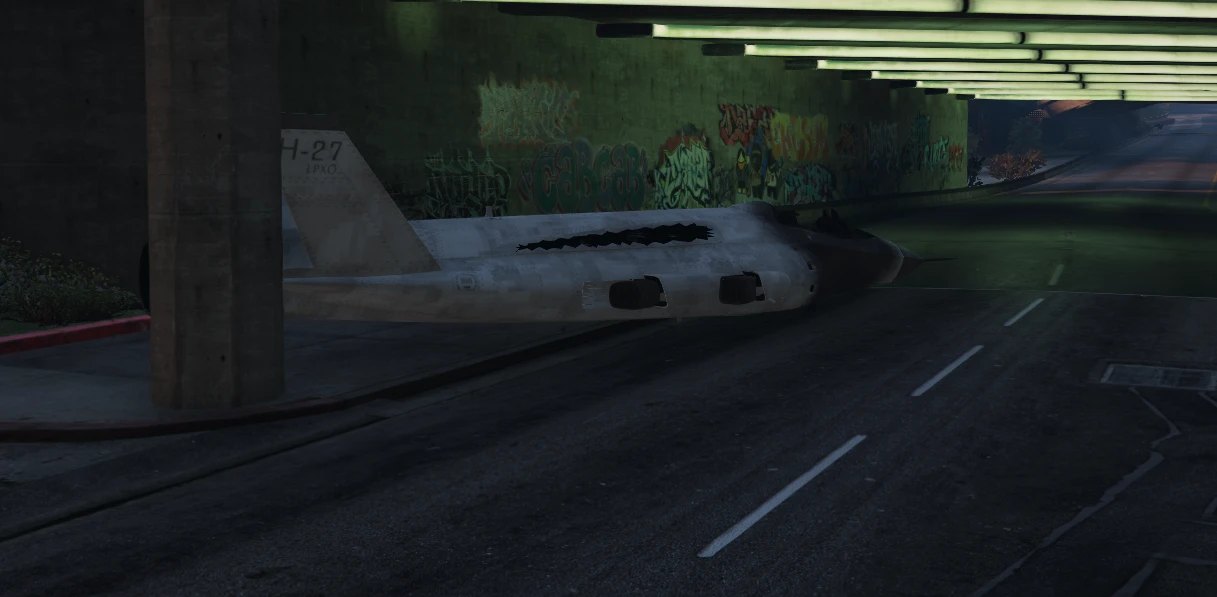
One structure does not appear in the totals at all. The overpass in Mission Row, beneath which the military jet the Air National Guard now calls an H-27 Hydra came to rest on Friday evening, is listed simply as “not inspected: military cordon”. The State says no aircraft was lost there.
Permits, plans and a City Hall that left town
Even on a cleared site, nothing can be built until somebody draws it, checks it and signs it off.
Marisol Quintero spent 22 years in City Hall’s permits office before retiring in the spring. “For a red-tagged block, the owner hires an engineer and an architect to decide whether to repair or replace,” she said. “Replace means a new design, probably to a new code. Then plan checks, the permit, inspections at every stage. In a normal year, that is six months before anyone digs.”
The office completes about 9,000 plan checks in a normal year, she said. The tally already lists 6,135 damaged buildings needing plans checked, from one building in fifteen; the planning sheet projects four to five times that for the whole city.
An emergency fast-track would need an order from the City Council and permits staff to run it. Quintero said former colleagues were among the staff ordered north on Friday, when Weazel News filmed vans leaving City Hall. Even State aid claims, on Form SA-1109, must be made in person in Pillbox Hill, inside the zone residents can be fined $25,000 for entering.
“Where does a plan go? Who checks it? Who signs it?” Quintero asked. “Right now the honest answer is nobody.”
No money, no workers, no materials
Everything above costs money, and the State of San Andreas is not paying. In Saturday’s statement signed by Harlan J. Mercer, Chief of Staff to the Governor, it froze every form of disaster assistance until a review finishes “no earlier than the second quarter of the next fiscal year”, and refused to ask for federal help.
Desmond Fairweather, who prices large building projects across Los Santos, put the cost of repairing and rebuilding what the documents describe, from the tagged buildings to the utilities, freeways and port, at $11 billion to $17 billion. “That is only what has been inspected,” he said. “It is a floor, not a ceiling. After every big earthquake, building costs jump in the first year, often by a fifth to a third.”
The Governor’s Los Santos Resilience Commemorative Coin costs $49.99. To raise the low end of that estimate, the State would need to sell about 220 million of them, and it says the proceeds go to the review holding up the aid.
Frank Oduya, business manager of the Los Santos Building Trades Council, said a rebuild this size needs 25,000 to 40,000 construction workers at its peak, against a Preservation Teams roster of 1,870. “My members are in Paleto, a lot of them in motel rooms Captain Kellow paid for,” he said. “There is nowhere to live in the city while you work, and nobody is offering contracts. You rebuild a city with contracts and payroll. The State froze the payroll.”
The concrete batch plants and steel yards that supply the east are in Cypress Flats and Elysian Island, inside the zone, and with the port restricted, most steel, timber, glass and pipe would come by road. Suppliers already want payment up front, Fairweather said. “Money is the first material. Without it, nothing else arrives.”
Who pays, and the clock on your front door
Colette Marchetti, a loss adjuster with 17 years of earthquake claims, said roughly one home in eight in Los Santos carries earthquake cover; ordinary home insurance excludes the ground moving. “Fire after an earthquake is usually covered. The shaking usually is not,” she said. “A family whose house burned down may be better off than the family next door whose house fell down.”
Even with cover, the excess is often 10 to 20 per cent of the home’s value, and no claim can be settled on a building an adjuster cannot see. “We can’t get into the zone, so claims can’t be assessed, so money can’t be paid, so builders can’t be hired,” Marchetti said. The only rebuilding money on offer is Maze Bank’s “Resilience Recovery Loans” at an APR of 24.9 per cent, for people who can prove income “from a workplace that still exists”.
Renters in red-tagged buildings may hold a lease on a home that no longer exists, and business owners may find their insurance does not cover a city that is simply closed.
Over all of it hangs the State’s Emergency Land Stewardship Act: property left unattended for more than 72 hours is “presumed abandoned” and may be handed to the State’s recovery partners. Most of the city was evacuated on Friday night, so that clock runs out on Monday evening, three days before the first bus leaves Paleto. Dynasty 8 is to lead a “Vinewood Renewal Initiative” to reimagine Los Santos as “a premium, lower-density lifestyle destination”, while Merryweather guards State and partner property inside the zone, authorised to use “proportionate force”.
Delacourt said a Preservation Teams coordinator had told him some blocks in the east would need “clearance from the State’s partners” before any machines went in. He did not know what that meant. Neither, he said, did the coordinator.
“When a block is red-tagged and the owner is sleeping in a motel car park in Paleto, time is on Dynasty 8’s side, not theirs,” said Beatriz Olmos of the East Los Santos Tenants Association. “Every month of delay is another month for someone else to decide what gets rebuilt, and who it gets rebuilt for.”
What Thursday can mean, and what it cannot
None of this makes Thursday a lie, and the teams have done real work: the main routes are largely clear, dozens of gas leaks are capped and power is back to most of the west and Downtown. But Thursday means much less than many people have heard.
A Thursday return most likely means people with green-tagged homes, mostly in the west and Downtown, going back to streets with power and, in many places, water they must boil. Yellow buildings open for short visits, or not at all. The worst-hit blocks of La Mesa, Murrieta Heights and Mirror Park stay fenced off, checkpoints remain, and Central Los Santos Medical Center stays closed.
Thousands of families will have nowhere to go back to: the tally puts about 21,500 homes inside the red and yellow buildings found so far. The State’s freeze covers temporary housing, and in Paleto, motels have been told to check whether guests can pay.
“Thursday is about opening the doors that are safe to open,” the engineer working with the teams said. “Nobody on the teams thinks the city is fixed. The problem is what people hear.”
A spokesperson for the Preservation Teams told Weazel News: “We have never said Los Santos will be rebuilt by Thursday. We said some residents may be able to come home. Those are different things.” The teams did not answer detailed questions about the figures.
We asked the Governor’s office what “clearance from the State’s partners” means and who grants it. It did not respond; its press office says replies to its statements “are not monitored”. Maze Bank, Merryweather and Dynasty 8, asked the same question, did not respond, nor did the Office of Emergency Management. The LSFD did not answer questions about its recovery crews; Chief Cole Walker has still not commented publicly.
The timeline: best case, likely, worst case
Not one expert Weazel News spoke to said Los Santos could be rebuilt in less than a year, even if everything goes right. To see why, follow a single lot.
Take a partly collapsed four-storey apartment block in La Mesa, one of the 311 recovery sites. Recovery there ends between about 10 November and early December. Then the detailed evaluation and the owner’s decision to repair or replace: weeks, once engineers and insurers can get in. Then an asbestos survey and removal: several more weeks. Then demolition, and a place in the queue for tips that need at least 320 days for the rubble already found. Soil investigation, where the ground is suspect, takes three to six months; design and permits about six months in a normal year. Only then does building start, and that takes one to two years.
Overlap every step that can be overlapped, assume the money arrives, and nothing new rises on that lot within a year. The people who lived there are unlikely to be home before late 2028.
Across the city, three things set the floor: the tips, which need 320 to 533 days for the debris already found; the work underground in the east, where the sewer survey alone takes six months, the water mains about four and a half, and two substations wait up to two years for transformers; and money, of which there is none.
At best, the calendar runs like this. Thursday: a partial return. Mid-October: every building inspected once. 10 November to early December: recovery ends. New year: gas back in the east. Spring: sewers surveyed, water mains replaced. Next autumn: the first new transformers. 2028: the port at full capacity, while the red-tagged blocks and nine red-tagged schools of the east are rebuilt one permit and one contract at a time.
Best case, if the ground stays quiet and the State releases money early, so emergency tips open, trucks run round the clock and engineers arrive from other cities: most of the city liveable within two to three months, the fences in the east down within nine to twelve months, and Los Santos working again about a year from now, its worst blocks still being rebuilt.
Likely case, with the aid freeze in place until at least the second quarter of next year and no outside help: 18 months to two years before the east is broadly back in use, and three to five years before what was destroyed is rebuilt.
Worst case, with another strong aftershock, a freeze that runs past the State’s own review date and red-tagged lots changing hands under the “presumed abandoned” rule: the best part of a decade for parts of the east, and some of it never rebuilt as it was. “It will be rebuilt as something,” Castellanos said. “Whether it is rebuilt for the people who lived there is a different question.”
The people waiting in Paleto
Delphine Okoro, 58, has lived in the same house in La Mesa for 24 years. When Weazel News showed her drone footage of her street, a red placard was visible on her front door. She looked at it for a long time.
“I was going to get on that bus on Thursday,” she said. “I had my bag packed. Now I don’t know what I’m getting on it for. To stand outside a fence and look at it?” She has no earthquake insurance, and she has heard about the 72-hour rule. “So what do I do? Go home to a house I’m not allowed in, so they can’t say I left it?”
Hector Salgado runs a tyre and brake shop in Cypress Flats. His building is yellow. “Say they let me open on Thursday. Who comes? My customers are in Paleto, their houses are red,” he said. “Maze Bank wants proof of income from a workplace that still exists. My workplace exists. My income doesn’t.”
A crane operator from the port, who asked to be identified only as Tomasz, said crews there had been told nothing. “If the port is half shut for two years, I don’t have a job for two years. Nobody has said that to us.”
A mother of two from Mirror Park, standing outside a motel on the Great Ocean Highway, put it more simply than any engineer. “Everybody keeps saying Thursday,” she said. “Nobody says what happens on Friday.”
Los Santos can start to reopen in a week. It cannot be rebuilt in one. Every document and every expert Weazel News has seen says the real number is at least a year, and for the people of the east, it may be a great deal longer.